Product plans
What’s Coming to RideDat: Features, Pricing, and Beta Access
Sometimes I just want to check the charge and get on with my day. Other times, I want to know why one ride used more energy than another—and I’m quite happy to open a spreadsheet to find out. RideDat needs to make sense for both kinds of day.
Caullen Omdahl ·
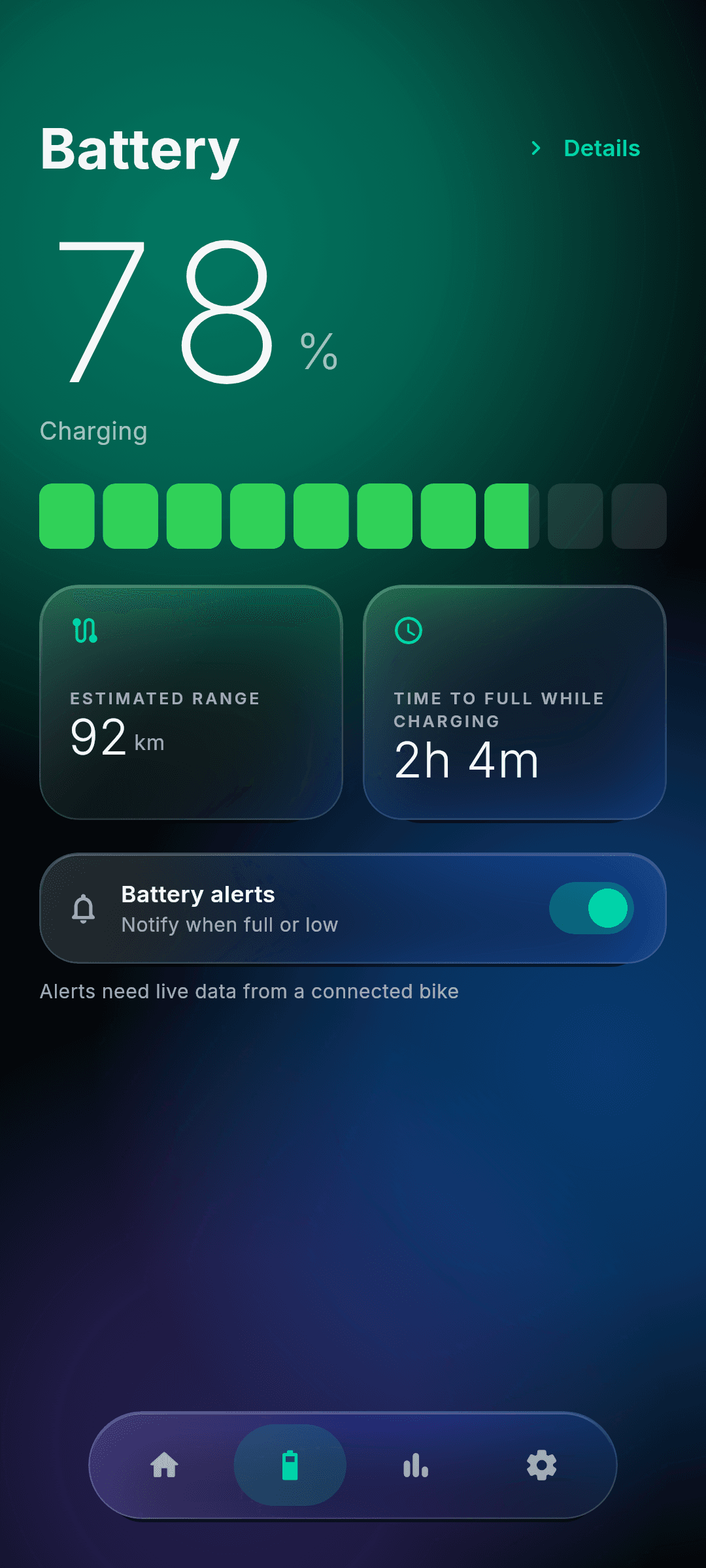
What would make your bike easier to live with?
For me, it started with wanting to understand my own bike. I wanted to compare rides, make sense of charging, and have a record I could come back to a few weeks later. You might want something much simpler: an easier way to check the bike before leaving, or to remember where you parked.
I want there to be room for both. RideDat is still in testing, and this is a good time to talk about what it could become. Here’s how I’m thinking about the different parts of the app, what should stay free, and how I hope to keep developing it.
The everyday stuff should just be there
You’ve already bought the bike. I don’t think checking its status or using its normal controls should mean taking on another subscription.
That’s the idea behind Basic: keep the dashboard, everyday controls, and firmware updates free when they’re available for your supported bike. If that’s all you need from RideDat, I want you to be happy using it that way.
The details of what a bike can show or do will depend on its model and firmware, but the principle is simple: the free app should be useful in its own right.
For the people who want to know more
I’m one of those people who sees an interesting reading and immediately wants to know what happened before it. Was that normal for this ride? Did it happen last week too? Can I look at the numbers myself?
Diagnostics Unlock is the part of RideDat I’m planning for that curiosity. The planned price is 99,000 VND, paid once, for permanent access to personal diagnostics. You wouldn’t need to keep a Pro subscription to keep that access.
I want the technical tools to make battery readings easier to understand, with useful charts, comparisons, and CSV exports for people who like working in a spreadsheet. I’m still working out exactly which tools belong in each package, based on what’s useful and what the bike can provide.
Keeping the connected features going
Some of the things I’d like to offer need more than the app on your phone. Keeping history when you change phones, sharing access to a bike, and bringing riders together around efficiency results all need services running behind the scenes.
That’s where Pro comes in. I’m aiming for 39,000 VND a month or 390,000 VND a year. The yearly option works out to 32,500 VND a month—roughly the price of a coffee here in Ho Chi Minh City.
That would help pay for hosting, upkeep, and the time to keep improving RideDat. History across phones, service records, weather, bike sharing, and optional efficiency leaderboards are the connected features I’m considering for the package.
I also like the small, practical things, such as remembering where you parked. That uses the phone’s location to save a spot; it doesn’t mean the bike has live GPS tracking.
These are planned prices. I’ll confirm the packages and subscription terms before paid plans launch.
A thank-you for helping me build it
Trying an unfinished app takes patience. Reporting a problem, explaining what happened, or coming back to test a fix takes time you could spend doing something else. I don’t want to take that for granted.
My plan is for approved beta testers to try the available features during testing, and for people who participate in the beta to keep Diagnostics Unlock for free when RideDat launches. It’s a way to say thank you with something you can continue using.
That lasting thank-you is for the diagnostics tier; full-feature testing access is temporary. I’ll explain how participation and eligible accounts are recorded before the beta begins.
And please bring ideas, not just bug reports. If there’s something you’ve been tracking by hand, or a question your current app never answers, I’d like to hear it.
Where I’d like to take it next
Era support is coming. Beyond that, I’d like RideDat to work with more motorbikes, with time spent developing and testing each model properly.
I’d like iPhone riders to be able to use it too. Getting there needs Apple hardware, development work, and testing. I want to do it well, so the timing will depend on demand and the resources I can put into it.
Firmware updates are another area I care about. As a rider, I want to understand what an update changes and whether other people have run into problems. I’d like RideDat to offer clearer change logs and known-issue information, with time to assess a release before offering it through the app.
Some of the ideas I keep coming back to
Could a service log and your odometer help you remember when maintenance is due? Could riders share a modification alongside what changed afterward? Could comparable battery data help us understand why some batteries seem to age differently, or when a recurring problem stopped appearing in newer bikes?
I don’t have all those answers yet. Those are things I want to explore carefully, rather than conclusions the app can make today. But they’re the sort of questions that make me want to keep working on this.
If any of that sounds useful—or if you think I’m missing something—I’d like you to be part of the conversation. The access page below has the current testing details. I’m looking forward to seeing what we learn from using RideDat on more than just my own bike.